About
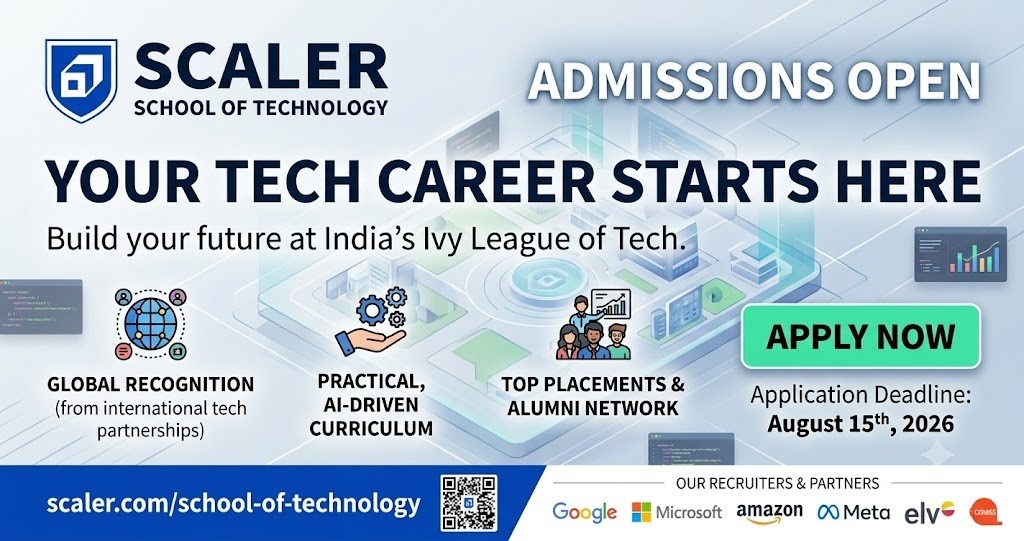
Scaler School of Technology (SST) is a next-generation undergraduate technology institution established by Scaler with the vision of reimagining engineering education in India. Designed for students who aspire to build successful careers in software engineering, artificial intelligence, and emerging technologies, SST combines a rigorous academic curriculum with extensive hands-on learning, industry mentorship, and real-world project experience. Unlike conventional engineering programmes that primarily emphasize theoretical concepts, Scaler School of Technology follows an industry-aligned learning model where students develop practical problem-solving skills through live coding sessions, collaborative projects, internships, hackathons, and continuous mentorship from experienced software engineers and technology leaders.
The institution aims to bridge the gap between classroom education and industry requirements by exposing students to modern software development practices from the beginning of their academic journey. The curriculum is regularly updated to reflect the latest advancements in Computer Science, Artificial Intelligence, Data Structures & Algorithms, Full-Stack Development, Cloud Computing, System Design, and other emerging technology domains. Students also gain exposure to collaborative learning, peer programming, technical workshops, coding competitions, and career development activities that prepare them for real-world engineering roles.
One of the distinguishing aspects of Scaler School of Technology is its strong focus on experiential learning and industry engagement. Students work on practical assignments, capstone projects, and real-world case studies while receiving mentorship from professionals associated with leading global technology companies. This learning methodology helps students strengthen their technical expertise, communication skills, and analytical thinking throughout the programme. In addition to academic learning, SST emphasizes career readiness by offering guidance in resume building, interview preparation, mock technical interviews, and professional skill development.
Scaler School of Technology also promotes a collaborative learning environment where students interact with mentors, industry experts, and peers to develop innovative solutions to complex technical problems. Through continuous assessments, project-based evaluations, internships, and exposure to current industry trends, students are encouraged to build strong foundations in computer science while preparing for long-term careers in the technology sector.
With its industry-driven curriculum, experienced mentorship ecosystem, practical learning approach, and emphasis on employability, Scaler School of Technology is emerging as a modern destination for students seeking an undergraduate education focused on software engineering and future-ready technology skills. The institution continues to strengthen its academic ecosystem by integrating innovation, industry collaboration, and practical learning into every stage of the student journey, helping graduates become capable professionals in the rapidly evolving global technology landscape.
New Programmes Introduced at Scaler School of Technology
Scaler School of Technology (SST) continues to strengthen its undergraduate education model by focusing on future-ready technology programmes that align with the evolving needs of the global software industry. Instead of launching numerous conventional degree options, the institution has adopted a specialized approach by offering an industry-focused undergraduate programme in Computer Science & Artificial Intelligence (CS & AI). The curriculum is designed in collaboration with industry experts to provide students with a strong foundation in computer science while developing practical expertise in modern technologies such as Artificial Intelligence, Machine Learning, Full-Stack Development, Cloud Computing, and System Design.
The programme integrates classroom learning with hands-on coding, live projects, internships, hackathons, and mentorship from experienced software engineers. Students are encouraged to solve real-world engineering problems through project-based learning and continuous industry exposure. The curriculum is updated regularly to reflect the latest technological advancements, ensuring graduates remain competitive in the rapidly changing technology landscape.
Rather than introducing multiple unrelated undergraduate programmes, Scaler School of Technology focuses on continuously enhancing its flagship Computer Science & Artificial Intelligence programme by incorporating emerging technologies, advanced software engineering concepts, AI-powered development tools, and experiential learning opportunities. This approach enables students to gain practical knowledge, build an industry-ready portfolio, and prepare for careers in software engineering, artificial intelligence, data science, and related technology domains.
Latest Programme Highlights
- 4-Year Residential Undergraduate Programme in Computer Science & Artificial Intelligence (CS & AI).
- Industry-oriented curriculum designed with practical software engineering concepts.
- Comprehensive learning in Data Structures & Algorithms, System Design, AI, Machine Learning, and Full-Stack Development.
- Hands-on projects, coding assignments, hackathons, and real-world case studies.
- Mentorship from experienced technology professionals and software engineers.
- Internship opportunities and career preparation integrated into the academic journey.
- Regular curriculum enhancements to keep pace with emerging technologies and industry requirements.
What’s New at Scaler School of Technology 2026?
Scaler School of Technology (SST) continues to redefine undergraduate technology education by strengthening its industry-first learning model for the 2026 academic session. The institution remains focused on delivering a practical, project-based curriculum that combines Computer Science fundamentals with emerging technologies such as Artificial Intelligence, Machine Learning, Cloud Computing, and Full-Stack Software Development. Instead of relying solely on classroom lectures, SST emphasizes experiential learning through coding labs, real-world projects, hackathons, mentorship, and continuous industry engagement.
For 2026, Scaler School of Technology continues to enhance its learning ecosystem by integrating modern software engineering practices, collaborative project work, and mentorship from experienced professionals working in leading technology companies. Students receive exposure to industry-standard development tools, coding workflows, technical interview preparation, and portfolio-building activities that help them become job-ready throughout their undergraduate journey rather than only during the final year.
The institution also continues its focus on personalized learning by offering smaller learning cohorts, continuous assessments, one-on-one mentor interactions, and practical assignments that encourage analytical thinking and problem-solving. Through workshops, technical events, coding competitions, and innovation-driven activities, students gain opportunities to strengthen both technical expertise and professional skills while staying aligned with the rapidly evolving technology industry.
2026 Highlights
- Industry-aligned Computer Science & Artificial Intelligence curriculum.
- Project-based learning with practical software engineering experience.
- Hands-on coding assignments, hackathons, and collaborative development projects.
- Mentorship from experienced software engineers and technology professionals.
- Continuous exposure to AI, Machine Learning, Cloud Computing, and modern development practices.
- Structured career preparation including resume reviews, mock interviews, and professional skill development.
- Regular curriculum enhancements to reflect evolving industry requirements.
- Strong emphasis on innovation, practical problem-solving, and real-world engineering skills.
How to Apply for Scaler School of Technology Admission 2026?
Applying for admission to Scaler School of Technology (SST) is a structured process designed to evaluate students on their academic background, aptitude, problem-solving skills, and interest in technology. The admission process goes beyond traditional marks-based selection and focuses on identifying candidates who have the potential to build successful careers in Computer Science and Artificial Intelligence. Eligible applicants are required to complete the online application, appear for the admission assessment (or apply through the Fast Track route if eligible), participate in interview rounds, and complete the admission formalities after receiving an offer. Students may also be considered for scholarships based on their performance and eligibility.
Step 1: Check Eligibility
Before applying, candidates should carefully review the official eligibility criteria. Applicants are generally expected to have completed or be appearing for Class XII with Mathematics as a compulsory subject and satisfy the academic requirements prescribed by Scaler School of Technology for the 2026 admission cycle.
Step 2: Complete the Online Application
Visit the official Scaler School of Technology admission portal and fill out the online application form. Candidates need to provide personal details, academic qualifications, contact information, and other required information. Applicants may also be asked to submit a short video essay explaining their motivation for joining the programme. The prescribed application fee should be paid to complete the registration process.
Step 3: Appear for NSET or Apply Through Fast Track
Most applicants are required to take the Scaler National Scholarship and Entrance Test (NSET), which evaluates mathematical aptitude, logical reasoning, and analytical skills. Candidates who meet the eligibility criteria for the Fast Track admission route through qualifying entrance examination scores, where applicable, may directly proceed to the interview stage according to the official admission guidelines.
Step 4: Attend the Interview Rounds
Shortlisted candidates are invited to participate in the interview process. The interviews are conducted to evaluate communication skills, mathematical thinking, logical reasoning, learning ability, and overall motivation for pursuing Computer Science and Artificial Intelligence. The interview process helps the admission committee understand each applicant beyond academic scores.
Step 5: Receive the Admission Offer
After reviewing the overall performance in the application, assessment, and interview stages, Scaler School of Technology announces the admission decision. Selected candidates receive an official admission offer along with scholarship information (if applicable) and detailed enrollment instructions.
Step 6: Confirm Your Admission
Candidates who receive an admission offer must complete the enrollment process by accepting the offer, submitting the required documents, paying the applicable admission fee, and completing document verification within the specified deadline to secure their seat.
Admission Process Highlights
- Online application through the official Scaler School of Technology website.
- Eligibility verification based on academic qualifications.
- Video essay submission as part of the application process.
- Scaler National Scholarship and Entrance Test (NSET) or Fast Track admission (where applicable).
- Personal interview rounds conducted by the admissions team.
- Merit-based scholarship opportunities for eligible candidates.
- Admission offer followed by fee payment and document verification.
Training & Internships
Training and practical industry exposure form one of the core pillars of the academic model at Scaler School of Technology (SST). Unlike conventional undergraduate programmes where students primarily focus on theoretical concepts during the initial years and begin practical training only towards the end of the degree, SST integrates hands-on learning from the very beginning. Students continuously develop their technical expertise through coding assignments, practical labs, collaborative projects, hackathons, technical workshops, and mentorship from experienced software engineers. The objective is to help learners build industry-relevant skills while pursuing their undergraduate education, making them better prepared for internships and future technology careers.
The curriculum is designed around experiential learning, enabling students to apply classroom concepts to real-world software engineering challenges. Throughout the programme, students work on projects involving Data Structures & Algorithms, Full-Stack Development, Artificial Intelligence, Machine Learning, Databases, Operating Systems, Cloud Computing, and System Design. Instead of relying solely on examinations, the institution emphasizes project-based assessments, coding exercises, peer collaboration, and technical problem-solving. This approach helps students develop practical coding skills, analytical thinking, debugging abilities, and software development experience that closely resembles professional engineering environments.
Students also receive continuous mentorship from experienced professionals associated with leading technology companies. These mentors guide learners through code reviews, project discussions, technical sessions, career planning, and interview preparation. Regular interactions with industry experts help students understand current software development practices, engineering workflows, and emerging technologies. The mentorship ecosystem enables students to strengthen both technical knowledge and professional confidence while learning directly from practitioners working in the technology industry.
Internship readiness is another major focus of the programme. Scaler School of Technology supports students through structured career development initiatives such as resume building, portfolio development, mock technical interviews, communication skills training, and professional mentoring. Students are encouraged to participate in internships, innovation challenges, open-source contributions, coding competitions, and industry events that provide valuable practical exposure. These experiences help learners understand workplace expectations, improve collaboration skills, and build an impressive technical portfolio before graduation.
Apart from technical development, SST also encourages students to participate in hackathons, startup initiatives, innovation projects, and community-driven learning activities. These opportunities enable students to work in teams, solve real-world engineering problems, and gain exposure to modern software development methodologies. By combining academic learning with continuous industry interaction, practical projects, and internship-oriented preparation, Scaler School of Technology aims to produce graduates who are equipped with both strong theoretical foundations and practical engineering skills required by today's technology industry.
Training & Internship Highlights
- Industry-oriented learning integrated throughout the undergraduate programme.
- Hands-on coding assignments and real-world software development projects.
- Project-based curriculum covering AI, Machine Learning, Full-Stack Development, Cloud Computing, System Design, and Computer Science fundamentals.
- Continuous mentorship from experienced software engineers and technology professionals.
- Technical workshops, coding contests, hackathons, and innovation challenges.
- Career development support including resume building, portfolio creation, and mock interviews.
- Opportunities to gain internship exposure and practical industry experience during the programme.
- Focus on building problem-solving, teamwork, communication, and software engineering skills.
- Exposure to modern development tools, collaborative coding practices, and engineering workflows.
- Preparation for technology careers through practical learning and industry engagement.
Note: Scaler School of Technology officially emphasizes practical training, industry mentorship, project-based learning, and internship opportunities as part of its undergraduate programme. However, the institution does not officially publish guaranteed internship statistics or claim that every student receives an internship. Therefore, no such claim has been included to maintain factual accuracy.
Industry Projects
At Scaler School of Technology, industry projects are designed to expose students to real engineering challenges instead of simulated classroom exercises. Throughout the programme, students work on practical software products, AI-based applications, scalable web platforms, and technology solutions that reflect real business use cases. The objective is to help students understand the complete software development lifecycle—from identifying a problem and designing a solution to development, testing, deployment, and continuous improvement.
Students complete 50+ real-world projects across multiple domains, including Artificial Intelligence, Machine Learning, Full-Stack Development, Cloud Computing, Distributed Systems, Data Engineering, and System Design. These projects encourage learners to apply theoretical concepts in practical scenarios while improving their coding standards, debugging skills, teamwork, and software architecture knowledge.
A major component of the programme is the 6-month Industry Immersion, where students work on industry-sponsored projects, internships, startup initiatives, or innovation-based assignments. This immersive experience helps students collaborate with experienced engineers, understand agile development methodologies, participate in code reviews, and contribute to production-level software development.
Students also gain access to the Scaler Innovation Lab, where they can build innovative products in Artificial Intelligence, Robotics, IoT, AR/VR, Drone Technology, and other emerging technology domains. The Innovation Lab supports research, experimentation, prototype development, and startup incubation, allowing students to transform innovative ideas into working products with guidance from mentors and industry experts.
Industry Project Highlights
- 50+ real-world software engineering projects.
- 6-month Industry Immersion programme.
- Industry-sponsored capstone projects.
- Hands-on product development experience.
- Innovation Lab for AI, Robotics, IoT and AR/VR.
- Startup incubation and product-building opportunities.
- Mentorship from experienced software engineers.
- Exposure to Agile development and collaborative engineering workflows.
- Portfolio development with production-ready projects.
- Practical experience solving real business problems.
Video
Scholarships
Scaler School of Technology (SST) is committed to making quality technology education accessible to deserving students through a comprehensive scholarship programme. To reduce financial barriers and encourage talented students from diverse backgrounds, the institution offers multiple scholarship opportunities that recognize academic excellence, technical achievements, extracurricular accomplishments, and financial need. These scholarships are awarded by the Scaler Impact Foundation, which supports students in pursuing an industry-integrated undergraduate education without financial constraints.
The scholarship programme is designed to identify students with exceptional potential rather than evaluating candidates solely on examination scores. During the admission process, applicants are assessed on various parameters such as Class X and Class XII academic performance, competitive examination scores, technical projects, coding achievements, Olympiads, extracurricular activities, leadership qualities, and overall aptitude. Students who demonstrate outstanding performance across these areas may become eligible for Merit-Based Scholarships.
In addition to academic merit, Scaler School of Technology also offers Merit-cum-Need-Based Scholarships for students facing genuine financial challenges. Applicants whose annual family income is below the prescribed eligibility limit can apply by submitting the required financial documents during the admission process. The scholarship committee evaluates both academic merit and financial circumstances before determining the scholarship amount. This ensures that deserving students receive financial assistance while maintaining high academic standards.
Scholarship applications are processed during the admission cycle while registering for the Scaler National Scholarship and Entrance Test (NSET). Candidates are required to complete their profile with accurate academic, extracurricular, and financial information, as these details form the basis for scholarship evaluation. Eligible students may receive scholarships of up to 100% of the tuition fee, depending on their overall assessment and the scholarship criteria applicable for the respective admission cycle.
Scholarships are generally awarded for the first academic year. Students may continue receiving scholarship support in subsequent years based on their academic performance, overall conduct, and fulfillment of the institution's continuation criteria. This performance-linked approach encourages students to maintain academic excellence throughout their undergraduate programme.
Scholarship Highlights
- Scholarships awarded through the Scaler Impact Foundation.
- Two major categories: Merit-Based and Merit-cum-Need-Based scholarships.
- Eligible students can receive up to 100% scholarship based on the evaluation process.
- Merit assessment considers academic scores, aptitude, technical achievements, projects, and extracurricular activities.
- Merit-cum-Need scholarships are available for eligible students facing financial challenges.
- Applicants are required to submit academic and financial details while registering for NSET.
- Financial documents such as income proof may be required for need-based scholarship evaluation.
- Additional consideration may be provided to promote diversity as per the institution's scholarship policy.
- Scholarships are initially awarded for the first year and may continue based on academic performance.
- Applying early can improve the opportunity for scholarship consideration during the admission cycle.
Note: Scholarship awards are subject to the official eligibility criteria, document verification, and evaluation process prescribed by Scaler School of Technology and the Scaler Impact Foundation. Receiving a scholarship is not automatic and depends on the applicant's overall profile and admission assessment.
FAQs
1. What is Scaler School of Technology (SST)?
Scaler School of Technology (SST) is an undergraduate technology institution by Scaler that offers an industry-focused education in Computer Science and Artificial Intelligence (CS & AI). The programme combines academic learning with hands-on projects, mentorship, internships, and practical software engineering experience.
2. What programme does Scaler School of Technology offer?
SST currently offers its flagship 4-Year Residential Undergraduate Programme in Computer Science & Artificial Intelligence (CS & AI). The curriculum is designed to prepare students for careers in software engineering, AI, machine learning, and related technology domains.
3. What is the admission process for Scaler School of Technology?
The admission process generally includes an online application, eligibility verification, the Scaler National Scholarship and Entrance Test (NSET) or the Fast Track route (for eligible candidates), followed by interview rounds and the final admission offer.
4. Who is eligible to apply for SST?
Students who have completed or are appearing for Class XII with Mathematics as a compulsory subject and satisfy the official eligibility criteria prescribed by Scaler School of Technology can apply for admission.
5. Does Scaler School of Technology provide scholarships?
Yes. SST offers merit-based scholarship opportunities for eligible students. Scholarship eligibility is determined according to the institution's admission guidelines and performance in the selection process.
6. Does SST provide internship opportunities?
Yes. The curriculum emphasizes practical learning through industry projects, hackathons, coding assignments, and internship opportunities, allowing students to gain real-world software development experience during their undergraduate studies.
7. What technologies are covered in the curriculum?
The curriculum includes topics such as Data Structures & Algorithms, Artificial Intelligence, Machine Learning, Full-Stack Development, Cloud Computing, System Design, Databases, Operating Systems, and Software Engineering, along with practical projects and coding exercises.
8. Does Scaler School of Technology offer placement support?
Yes. SST provides structured career support that includes resume building, interview preparation, mock technical interviews, mentorship, portfolio development, and career guidance to help students prepare for technology roles.
9. Is Scaler School of Technology a residential programme?
Yes. SST is designed as a residential undergraduate programme, where students learn in a collaborative campus environment with access to academic, technical, and extracurricular activities.
10. Where can students apply for Scaler School of Technology admission?
Students can submit their applications through the official Scaler School of Technology website, where they can access the latest information on eligibility, admissions, scholarships, and important application deadlines.